
India is closely monitoring Sri Lanka's decision to offer foreign investors control of an airport near the China-controlled Hambantota port, as it could present a rare opening for Indian firms seeking strategic footholds in the Indian Ocean.

The southern deep-sea port of Hambantota is considered strategically important for its location.

The Sittwe deal is more significant than Chabahar in Iran, where India has rights to operate only two terminals and not the port itself.

India's involvement in the port development was not strictly under the international sanctions that had been imposed on Iran.

Sri Lankan President Mahinda Rajapaksa arrived in Beijing on Monday on a 4-day state visit, his sixth, with Colombo saying that its ties with Beijing were not an "exclusive one" and would not harm interests of others.
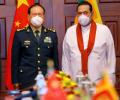
China said it has suspended the project due to security concerns from a third party.

China has invested millions in Sri Lankan infrastructure.

The two sides are also likely to firm up a currency swap framework and seal several other agreements including one on debt restructuring following talks between Modi and Sri Lankan President Anura Kumara Disanayaka on April 5, people familiar with the matter said.
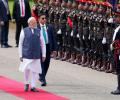
'Granting the country's highest civilian honour to Prime Minister Modi was surprising as it indicated the government was going out of its way to have India as a close partner.'

At the end of October, Sri Lanka President Maithripala Sirisena handed over the deeds for the transfer of 116 hectares in Colombo Port City to China Harbour Engineering Company on a 99-year lease to build a financial centre.

Both Mahinda Rajapaksa and Modi have learnt from their past mistakes. Modi has understood that Rajapaksa is a 'forever politician' that India has to live with, observes Ambassador M K Bhadrakumar.

'We will likely never know why Xi decided not to travel to New Delhi. One possible explanation could be his desire to avoid a meeting with US President Joe Biden.'

'We should expect a cold-blooded, transactional relation that requires a lot of engagement and mutual trust to sustain,' says Constantino Xavier, Fellow, foreign policy, Brookings India.

'Gotabaya will expect India to observe the red line.' 'He even dispensed with any gesture welcoming India as an interlocutor on the Tamil issue.' points out Ambassador M K Bhadrakumar.

'The separatist resurgence in Balochistan is thwarting Pakistan's plans to build CPEC projects to optimally utilise Balochistan's energy reserves,' points out Brigadier Gurmeet Kanwal (retd).

'The accusation that Pakistan risks losing sovereignty to China is emotive and has the potential to spread.' 'China will, however, remain intent on achieving its strategic ambitions of acquiring Gwadar port and securing a large chunk of Pakistan occupied Kashmir,' says former RA&W officer Jayadeva Ranade.

'India needs to learn in Kashmir how to spread development.' 'Pakistan needs to learn in Balochistan how to spread development.' 'China needs to learn in Xinjiang and Tibet.' 'And if they can show tangible benefits, there will be less terrorism.' 'No one wakes up in the morning saying 'I want to kill myself', right?'

The aircraft carrier is China first domestically-built ship. Shandong is bigger than China's first aircraft carrier Liaoning and could house 36 fighter jets.

Rajapaksa has blamed India, the United States and European countries for his humiliating defeat.
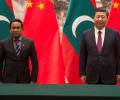
Chinese Foreign Ministry said international community should respect sovereignty and independence of the Maldives.
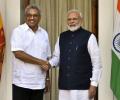
New Delhi is approaching Gota with an open mind, observes N Sathiya Moorthy.

Colombo seems to be veering to the middle path between China and the US on global matters, but in regional matters of strategic security, it is increasingly identifying with India, points out N Sathiya Moorthy.

The decision to not attend the forum attended by 28 heads of state and 130 national delegations is a clear break from its usual policy of going along with the crowd.

From Sri Lanka's most popular political family to its most despised -- going by the voices on the streets calling for the Rajapaksas' ouster -- what went wrong for the clan? Veteran Sri Lanka watcher N Sathiya Moorthy offers an insight.

The prejudices the Chinese carry with them mean they are not natural global managers.

'There is no Buddha or Gandhi among countries, existing for the service of others; they all exist for the good of themselves.' 'For each country, its own interests should be paramount, and it is futile and churlish to expect China to be an exception to this rule,' says B S Raghavan, the distinguished civil servant and long-time China-watcher.

'Despite the current tension at Doklam and the risk of escalation on the Himalayan land frontier, it is the Indian Ocean we need to worry about more,' says Nitin Pai.
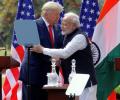
'New Delhi and Washington are now on the same page, on dealing with growing Chinese assertiveness, across the entire Indo-Pacific region,' notes Ambassador G Parthasarathy, Chancellor, Central University of Jammu.

'With the recent challenging of the notion of the Indian Ocean Region being India's strategic backyard, China is gradually upping the ante in the maritime realm around India.'
